
Corrugated Packaging for Bakeries: When to Use It and How to Choose the Right Box
For many bakeries, a standard paperboard box is enough for counter sales and customer pickup. The requirements change when cakes, cookies, or dessert boxes need to be stacked, delivered between locations, or shipped through a parcel network. In these situations, the packaging has to carry more weight and withstand more handling.
Corrugated packaging can provide the extra structural support needed for these uses, but not every bakery product requires a corrugated box. The right choice depends on the product size, packed weight, delivery method, and storage conditions.
This guide explains the main types of corrugated packaging for bakeries, when to use them, and how to choose the right box for different products and delivery routes.
1.What Is Corrugated Packaging?
Compared with solid paperboard, this structure provides better support and cushioning, making it more suitable for bakery packaging that needs to carry weight, be stacked, or go through repeated handling.
How Corrugated Board Is Built
A typical corrugated board is made from two flat paper liners with a fluted layer, known as the corrugating medium, bonded between them.
The fluted layer gives the board its structure and helps prevent the box from bending under weight or stacking pressure. The spaces created by the flutes also absorb some of the impact that occurs during handling and transport.
Corrugated Board vs. Paperboard
Paperboard is generally made from paper pulp and formed into a solid, single-layer sheet. It is thinner, lighter, and easier to fold and print in fine detail. Bakeries commonly use it for cake, cookie, and macaron boxes, as well as other retail pastry packaging.
Corrugated board is less often chosen for highly decorative, multi-coloured retail graphics, as its main role in bakery packaging is usually protection. The fluted layer provides additional structural support, making it better suited to outer mailer boxes, delivery cases, multi-box shipments, and packaging that must withstand more demanding transport conditions.
The two materials serve different purposes. Paperboard is often better suited to product presentation and customer pickup, while corrugated board is more commonly used to protect products during delivery and shipping. In some bakery packaging systems, both materials are used together—for example, a printed cookie gift box may be packed inside a corrugated outer mailer.
2.Common Corrugated Box Styles for Bakeries
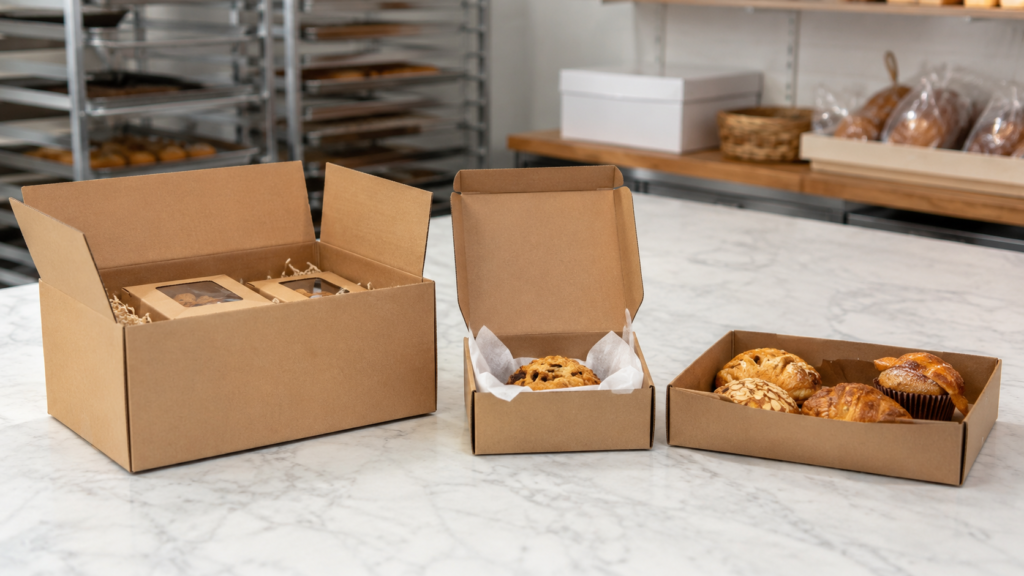
Corrugated packaging is not limited to traditional shipping cartons. Depending on the product, packing method, and delivery requirements, corrugated board can be made into outer shipping cases, mailer boxes, and delivery trays.
For bakeries, the right box style depends on the job the packaging needs to do. Some formats are designed to move several retail boxes together. Others need to provide both product protection and a better unboxing experience. Certain styles are better suited to the bulk delivery of bread, pastries, and other baked goods.
Regular Slotted Shipping Cases
A regular slotted container, commonly used as a corrugated shipping case, is one of the most common box styles for bakery distribution. It has opposing flaps at the top and bottom and is usually sealed with tape after packing. In bakery operations, this type of case is generally used as the outer shipping carton rather than as a replacement for retail cake boxes or cookie boxes. Several cake boxes, pastry boxes, or individually packed products can be placed inside one case before being delivered to different bakery locations, coffee shops, or retail customers.
This format works well for central kitchen distribution, store replenishment, and wholesale bakery orders. Its regular internal shape also makes it easier to plan how many retail boxes can be packed into each case. Dividers or pads can be added where needed to reduce movement during transport.
Corrugated Mailer Boxes
A corrugated mailer box is usually made from a die-cut, folding structure with the lid attached to the main body. Once assembled, it closes with tabs or locking flaps. Compared with a standard shipping carton, this style looks and opens more like retail packaging. It is commonly used for cookies, brownies, dessert gift sets, and online bakery orders. For dessert brands selling through Instagram, their own websites, or other online channels, a corrugated mailer can provide a useful balance between shipping protection and brand presentation.
The mailer itself, however, does not stop products from moving inside the box. Fragile cookies, macarons, or mixed dessert assortments often need inserts, dividers, or other forms of internal support.
Corrugated Trays
Corrugated trays usually have an open-top or low-sided structure, making products easier to load, carry, and remove. Depending on how they will be used, they may also include higher side walls, carrying handles, or features that allow the trays to be stacked. In the bakery industry, corrugated trays are commonly used to package bread, croissants, pastries, and other products for delivery in larger quantities. For bakeries supplying stores, coffee shops, or restaurants each day, this format can reduce the need to move products one box at a time. It also makes stock easier to count and products quicker to access.
Corrugated trays can also be used with an outer cover or shipping case for added protection during delivery. Once they arrive at the destination, suitable tray designs can also be used for short-term product display or easier access during service.
3. The Strengths and Limits of Corrugated Packaging
One of the main advantages of corrugated packaging is that it provides added support and cushioning without adding unnecessary weight. The fluted layer helps distribute pressure across the board, allowing the package to hold its shape more effectively under load, during stacking, and after repeated handling.
For bakery packaging, this structure is especially useful for orders that need to be delivered or moved in larger quantities. When several cake boxes are packed into a single shipping case, the outer box must withstand stacking pressure. Cookie or brownie gift boxes sent through a parcel network also benefit from a more stable outer package that helps reduce the effects of impact and compression on the individual products inside.
Corrugated board is relatively lightweight, and many box styles can be shipped and stored flat, helping to reduce the space occupied by empty packaging. It can also be custom printed and made into mailer boxes, delivery trays, and other formats that combine product protection with brand presentation.
However, corrugated packaging cannot solve every packaging problem on its own. A stronger outer box will not stop products from moving inside. Fragile cookies, macarons, and mixed dessert assortments often still require inserts, dividers, or other internal support. For heavier cakes, corrugated packaging alone may not be enough. The strength of the cake board and the support beneath the product are just as important.
Corrugated board is also not automatically grease-resistant, moisture-resistant, or suitable for direct food contact. Whether unpackaged food can safely touch the material depends on the paper, inks, adhesives, and surface treatments used. Chilled products, high-humidity conditions, and baked goods with a higher fat content may also require food-safe liners, greaseproof paper, trays, or separate inner packaging.
4.When Should Bakeries Use Corrugated Packaging?
Not every bakery order needs corrugated packaging. For in-store sales, short customer pickups, or lighter cakes, cookies, and pastries, a standard paperboard box often provides sufficient presentation and basic protection. The need for corrugated packaging usually depends more on what the product will go through after it leaves the
(1).When several cake boxes or dessert boxes need to be moved from a central kitchen to different bakery locations, corrugated shipping cases are often a practical choice. They allow multiple retail boxes to be packed together, making handling, stock checks, and store replenishment more efficient. For bakery groups with several locations, using standard outer case sizes can also simplify delivery and help reduce pressure on retail boxes during repeated loading and unloading.
(2).Corrugated packaging may also be useful for local delivery, wedding orders, and events, especially when several cakes, cupcakes, or dessert boxes need to be transported at the same time. These orders may not go through a parcel network, but vehicle movement, repeated handling, and stacked boxes can still create packaging risks. The need for a corrugated outer case should be determined by the product weight, delivery distance, and how the order will be loaded into the vehicle.
(3).For brands selling cookies, brownies, and dessert gift sets through Instagram, their own websites, or other online channels, parcel shipping usually places greater demands on the packaging. Parcels may be sorted, stacked, and turned in different directions several times, so a retail gift box on its own may not provide enough protection. A corrugated mailer or outer shipping case can add another protective layer, while inserts or dividers help keep the products stable inside.
(4).Bakeries supplying coffee shops, restaurants, hotels, or retail stores also commonly use corrugated cases or trays. Compared with moving products one box at a time, consolidated packaging simplifies bulk delivery, unloading, and routine stock replenishment.
A simple way to decide is to look at how the package will be handled. If the packaging only needs to support in-store sales and customer pickup, a standard paperboard box is often enough. If the products will be packed in larger quantities, handled several times, stacked, delivered between locations, or sent by parcel, corrugated packaging is worth considering.
5.How to Choose the Right Corrugated Box
When choosing corrugated packaging, many buyers start by asking how thick the board is and whether the box is strong enough. The problem is that buying the thickest or strongest option can easily lead to overpackaging. Once the boxes arrive, the extra strength may prove unnecessary, while the packaging cost is higher than it needs to be.
The same box style can face very different demands depending on how it is used. A box carrying cookies on a short local delivery does not need to handle the same weight or shipping conditions as a case holding several cake boxes. The right corrugated packaging should be specified around the product, the packing arrangement, and the actual delivery route before the board construction is finalized.
Start with the Product and Delivery Route
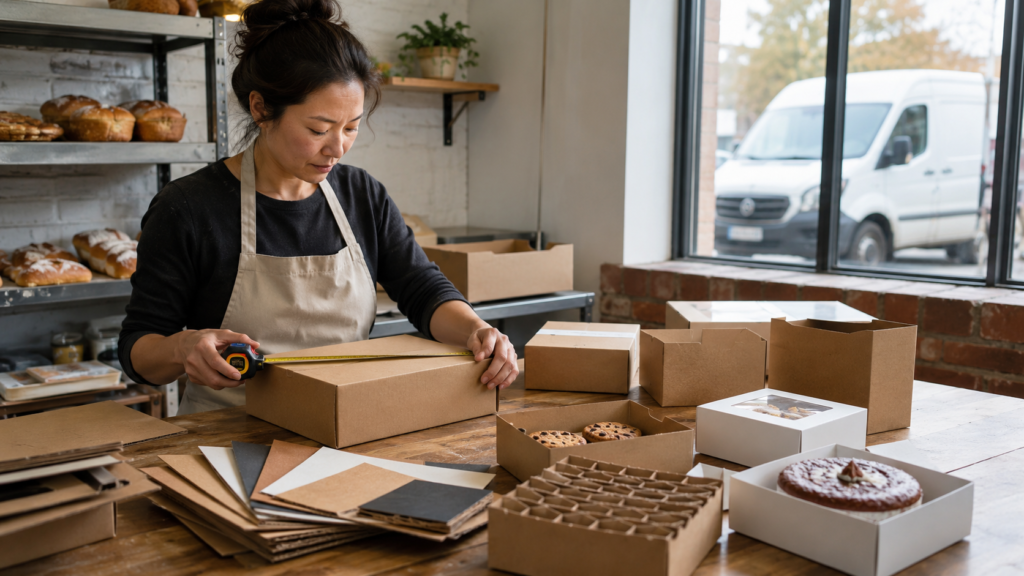
Start with the actual product dimensions and the total weight of the finished pack. If the corrugated case will hold several smaller retail boxes, you also need to know how many boxes will fit in each case, how they will be arranged, and whether the weight will be evenly distributed. For cakes, the cake board, decoration height, and retail cake box must all be included. For cookies, macarons, and mixed dessert assortments, it is also important to consider how fragile the products are and whether they may move inside the package during transport.
The internal dimensions should be based on the fully packed product. A box that is too small may press against cake decorations or make retail boxes difficult to load. A box that is too large leaves unnecessary space, allowing products to move during transport. This can increase the need for filling materials, add to shipping volume, and create a greater risk of product damage.
Once the size and weight are clear, consider what the package will actually go through during delivery. Short local deliveries usually involve vehicle transport and manual handling. Longer routes from a central kitchen may involve repeated loading and unloading and multi-box stacking. Parcel shipments can go through several sorting stages, orientation changes, and more demanding transport conditions.
Even when the product is the same, a different delivery method may require a different board construction. A box of cookies collected directly from the bakery will not need the same level of protection as a box of cookies traveling through a parcel network for several days.
Choose the Right Flute and Board Construction
Once the product and delivery conditions are understood, the next step is to choose the flute profile and board construction. Each flute profile performs differently in terms of thickness, cushioning, compression strength, and print quality.
| Flute Type | Typical Finished Board Thickness | Common Bakery Packaging | Best Suited to | Key Characteristics |
| E Flute | Approx. 1.5–2 mm | Cookie boxes, brownie gift boxes, small dessert boxes, and branded mailer boxes | In-store retail, local delivery, and lighter online orders | A thinner profile with a relatively smooth surface. It creates a more compact finished box and works well when both presentation and basic transport protection are important. |
| B Flute | Approx. 2.5–3.5 mm | Multi-box cake delivery cases, dessert shipping cases, and trays for bread and pastries | Central kitchen distribution, multi-location replenishment, multi-box transport, and routine bulk delivery | Provides a practical balance of structural support and cushioning. It is commonly used for delivery packaging that needs to withstand handling and stacking. |
| C Flute | Approx. 3.5–4.5 mm | General shipping cases, larger pastry transport boxes, and outer packaging for heavier products | Wholesale distribution, medium- to long-distance delivery, and orders requiring additional cushioning | A thicker flute profile that provides more cushioning space. It is generally used where transport protection is the main priority. |
These thickness ranges are general references rather than fixed specifications. The finished board thickness can also vary depending on the outer and inner liners, the fluting medium, the paper weights, and the manufacturing process.
Along with the flute profile, you also need to decide between single-wall and double-wall board. For smaller mailer boxes and delivery cases that carry a moderate weight, a suitable grade of single-wall board is often sufficient. Double-wall board can provide additional support for heavier products, larger shipping cases, or more demanding transport conditions, but it also uses more material, increases package weight, and takes up more space.
For this reason, double-wall board is not automatically the better choice. Over-specifying the board can increase cost and use more material than the application actually requires. A more practical approach is to select a construction that is strong enough for the packed weight, box size, stacking method, and delivery conditions.
Flute type and the number of corrugated walls are not the only factors that affect performance. The linerboard, fluting medium, paper weight, and material grade also play a part. Two boxes made with E flute can still perform very differently in terms of load-carrying capacity and compression strength.
When confirming a custom specification, it is better to review the full board construction rather than simply asking for E flute or B flute.Confirming these details before ordering helps avoid paying for material that the packaging does not actually need.
Do Not Judge Box Strength by Thickness Alone
Many bakery owners judge box strength mainly by board thickness. Thickness is easy to see and compare, but it does not give a complete picture of how a finished corrugated box will perform.
Paper grade, flute formation, box dimensions, flute direction, and structural design all affect the performance of the finished box. Features such as handles, cut-outs, crease lines, and locking tabs can improve usability but also alter how stress is distributed throughout the box.
Even a large box made from relatively thick board may still develop bulging side panels, a sagging lid, or a distorted base if its panels are too wide or the weight inside is unevenly distributed.
Storage and handling conditions also matter. Paper-based packaging can be affected by humidity and condensation. Corrugated boxes used for chilled desserts, temperature-controlled delivery, or high-humidity environments should be tested under conditions close to their intended use, rather than judged solely as empty boxes in a dry room.
The final assessment should be based on the complete package with the actual product inside, not on a sheet of corrugated board or an empty box.
Before mass production, use the actual product and the final packed weight to assess fit, stacking performance, handling, and delivery conditions. For packaging that will be sent by parcel, a small trial shipment can help show how the outer box, inner packaging, and product perform by the time they reach the customer.
For more detailed performance data, the board’s Edge Crush Test (ECT) rating and the finished case’s compression performance can also be reviewed.
The right corrugated box is not necessarily the thickest or heaviest one. It is the box that provides sufficient support for the product under handling and delivery conditions without using more material than necessary.
6. What to Check Before Ordering Custom Corrugated Boxes
Before ordering custom corrugated packaging, make sure the product details, intended use, and packaging requirements are clearly defined. Clear specifications make it easier for the supplier to recommend the right box style, dimensions, and board construction. They also reduce unnecessary revisions, unexpected costs, and the risk of ordering packaging that does not suit the intended use.
What to Confirm | Information to Provide | Why It Matters |
Product details | Product type, dimensions, and individual product weight | Helps determine the required packing space and basic load-bearing needs |
Packing arrangement | Quantity per case, product layout, and final packed weight | Affects the case dimensions, internal layout, and board construction |
Intended use | Store delivery, multi-location replenishment, wholesale distribution, or parcel shipping | Different delivery methods involve different levels of handling and transport risk |
Box dimensions | Length, width, and height, and whether the measurements refer to internal or external dimensions | Helps avoid an overly tight fit, excessive space, or loading difficulties |
Board specification | Flute type, single-wall or double-wall construction, linerboard, and material grade | Helps ensure the board is suitable for the actual application without using more material than necessary |
Internal protection | Inserts, dividers, pads, or other forms of internal support | Helps reduce the movement of products or retail boxes during transport |
Printing requirements | Logo, colours, print position, and print coverage | Helps determine the printing method, artwork requirements, and production cost |
Food-contact requirements | Whether the product is exposed or packed with greaseproof paper, an inner bag, a tray, or a retail box | Helps determine the appropriate materials, inks, and inner-packaging requirements |
Order details | Order quantity, required delivery date, and any seasonal demand | Affects production planning, cost, and delivery arrangements |
Before mass production, approve the structural sample and test the finished pack under conditions that reflect how it will actually be stored, handled, and delivered.
7.FAQ
Can corrugated packaging come into direct contact with baked goods?
Yes, but the paper, inks, adhesives, and surface treatments should be suitable for the intended type of food contact. In practice, corrugated packaging is more commonly used as an outer protective layer, while the food is first placed in greaseproof paper, trays, food bags, or retail boxes.
Should bakeries choose stock corrugated boxes or custom packaging?
For smaller order volumes or products that are still being tested, stock boxes are usually the more flexible option. For products with stable dimensions and ongoing sales, custom packaging is often a better choice because it allows better control over internal space, brand presentation, and packing efficiency.
Can one corrugated shipping case accommodate different sizes of cake or dessert boxes?
Yes, as long as the size differences between the retail packages are not too large. Adjusting the packing arrangement or adding dividers and pads can make the outer case more versatile, but it is not advisable to leave excessive space simply to accommodate more product sizes.
Do seasonal bakery gift boxes need completely new corrugated packaging?
Not necessarily. If the product dimensions and packing arrangement remain the same, the existing box structure can be retained while the printing, stickers, or sleeves are updated. The packaging usually only needs to be redesigned when there are significant changes to the product assortment, quantity, or internal structure.
What design files are needed for custom corrugated boxes?
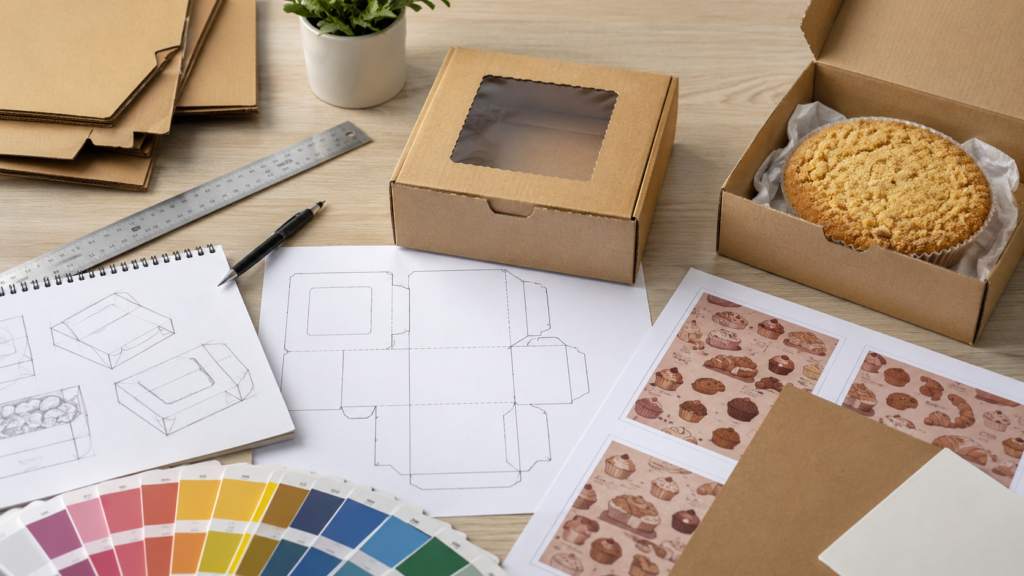
For branded printing, provide a vector logo or complete artwork file, along with confirmed brand colors, print positions, and text content. Before production, the final artwork should also be checked against the approved dieline to prevent graphics from interfering with crease lines, locking tabs, or glue areas.
Conclusion
The right corrugated packaging is not necessarily the thickest option. It should provide enough protection for the product, packing method, and delivery conditions without adding unnecessary material or cost.
With more than 25 +years of experience in packaging and printing, EVER GREATER has worked with bakeries, dessert brands, restaurants, and online food businesses on a wide range of custom packaging projects. If you are planning a new corrugated mailer, delivery case, or bakery shipping package, contact us to discuss a solution tailored to your products and packaging use.