
Cookie Packaging Ideas for Selling, Shipping, and Gifting
Over the years, we have worked with many customers looking to upgrade or customize their cookie packaging. One of the first questions they often ask is, “What is the best type of cookie packaging?” Instead of immediately recommending a particular format, our designers usually begin with a different question: “What kind of cookies do you sell?”
Packaging decisions should always start with the product itself. Thin and crispy cookies, thick cookies, stuffed cookies, and decorated sugar cookies differ significantly in size, weight, fragility, and presentation requirements. A packaging format that works well for one type of cookie may be completely unsuitable for another.
Once we understand the cookies, we also need to consider how they will be sold. Only after the product and sales method have been clearly defined can the right packaging format be selected. This article looks at these practical considerations, introduces a range of cookie packaging styles, and helps you determine which options are best suited to your products and your business.
1.Why Cookie Packaging Is Not One Size Fits All
Before requesting custom packaging or upgrading your current packaging, you first need a clear understanding of the cookies you sell. Their diameter and thickness, whether they are crisp or soft, whether they have icing, how easily they crumble, and how many will be packed in each box may all seem like basic details. In practice, however, they directly affect the box height, the way the cookies are arranged, and whether individual wrapping, paper cups, or dividers are needed. The following cookie types each require a different packaging approach.
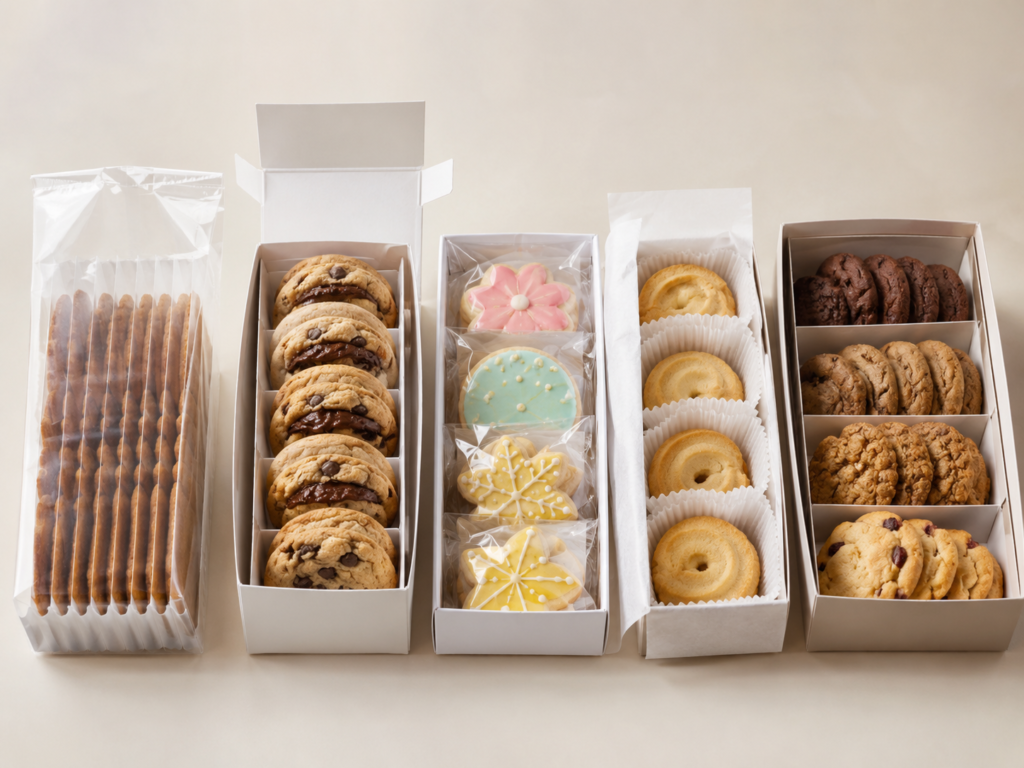
Thin and Crispy Cookies
Thin, crispy cookies are easily broken. If there is too much empty space inside the box, they can shift and knock against one another during handling. If they are stacked too high, the cookies at the bottom may be placed under too much pressure.
A compact arrangement is usually more suitable, supported by sealed bags, paper cups, or dividers where needed. The packaging should not only limit movement but also reduce prolonged exposure to air, which can cause crisp cookies to absorb moisture and lose their texture.
Thick and Stuffed Cookies
Thick and stuffed cookies are usually heavier, and chocolate chunks, nuts, fillings, or other toppings often rise above the main surface of the cookie. For this reason, the internal box height should not be calculated from the average thickness alone. Additional clearance must be allowed for these raised ingredients.
Decorated Sugar Cookies
The icing, sprinkles, and raised decorations on sugar cookies can easily be scratched during packing or transport, so the cookies should not come into direct contact with one another. Protecting the design is therefore the main packaging priority. Individual wrapping, shallow compartment boxes, or boxes with fitted inserts are all practical ways to keep each cookie separate and reduce the risk of surface damage.
Butter and Crumbly Cookies
For butter cookies and cookies that produce a lot of crumbs, the inner packaging is often more important than the outer box. To prevent grease and crumbs from coming into direct contact with the paperboard, these cookies should be protected with paper cups, grease-resistant paper, sealed inner bags, or lined containers.
Assorted Cookie Collections
Assorted cookie gift boxes usually place the greatest demands on the internal structure. The cookies may vary in diameter, thickness, and firmness, so the position of each cookie should be planned before the outer box is selected.
Dividers, paper cups, and individual wrapping are not simply optional accessories in this type of pack. They are part of the packaging system and help keep different cookies separated, stable, and neatly presented.
2.Cookie Packaging Ideas by Packaging Style
When looking for packaging inspiration, images can show whether a design is attractive, but attractive packaging is not always practical.
The following packaging formats can all be customized in size, material, color, and print. If you need packaging developed around your own cookie size, pack count, branding, or sales method, our custom cookie boxes can be tailored to match those requirements.
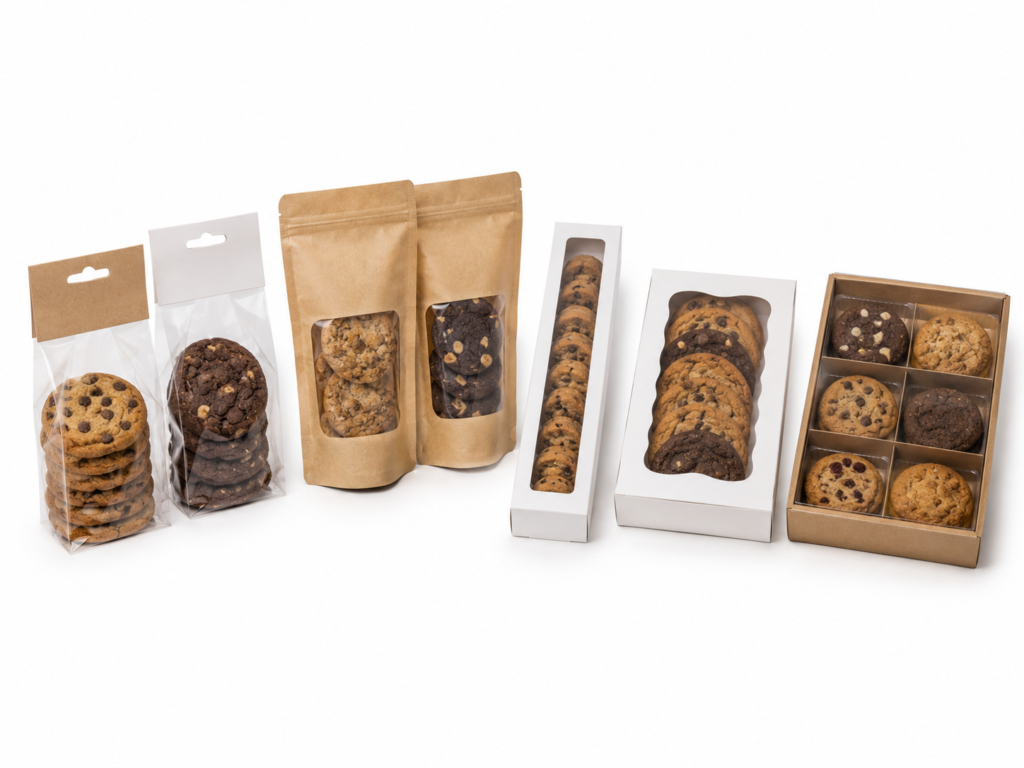
(1)Individual Cookie Bags with Header Cards
Individual clear bags are one of the simplest ways to package cookies. They keep the cookie fully visible, while a printed header card, sticker, paper sleeve, or hang tag can be added to provide branding and flavor information.
For cookies that need to stay crisp or avoid direct surface contact, the bag can also be heat sealed. This format works particularly well for decorated sugar cookies, logo cookies, wedding favors, and oversized single cookies.
(2)Window Stand-Up Pouches
Window stand-up pouches are suitable for mini cookies, cookie crisps, and small butter cookies. The pouch stands upright on a shelf, while the clear window allows customers to see the product inside. The top can be finished with either a resealable zipper or a heat-sealed closure. This format works well for bakery shelves, cafés, and market stalls. Different pouch colors can also be used to distinguish between flavors. Compared with a paper box, it is lighter and requires no on-site assembly.
However, cookies are usually packed loose inside a stand-up pouch, so the level of protection is limited. Fragile cookies, decorated cookies, and products that need a neatly arranged presentation should not be mixed loosely in this type of packaging.
(3)Slim Window Cookie Boxes
Slim window cookie boxes are usually designed to hold cookies in a single row. The box is narrow, with a long window across the top, and commonly holds four or six cookies.
This structure works particularly well for thick cookies, stuffed cookies, and cookies topped with visible chocolate chunks or nuts. The neat single-row arrangement makes different flavors easy to see and gives the packaging a more distinctive appearance than a standard square box. Cookies packed together in this format should generally be similar in size. Assortments containing cookies with noticeably different dimensions are not recommended for this type of box.
(4)Shallow Window Cookie Boxes
Shallow window boxes are among the most common and practical options for long-term use in bakery stores. A large window makes them suitable for displaying assorted flavors, while the remaining paperboard area provides space for a logo, flavor details, or branded artwork.
For bakery brands with several locations, this format also makes it easier to standardize pack counts and packing procedures across different stores.
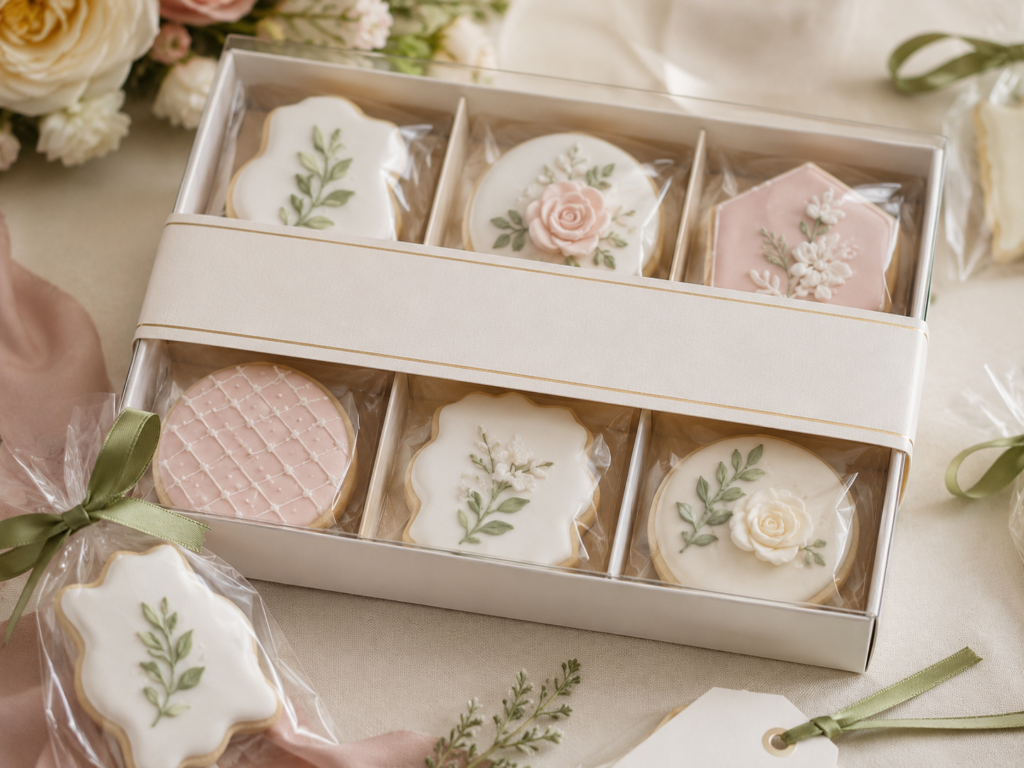
(5)Clear-Lid Compartment Boxes
The main advantage of a clear-lid compartment box is the way it organizes the cookies. Each cookie has its own position, allowing customers to see the complete set clearly, whether or not the box has been opened.
This packaging is particularly suitable for decorated sugar cookies, shaped cookies, wedding collections, and custom corporate cookies. A white or light-colored insert keeps the attention on the cookies, while the clear lid creates a complete display without requiring extensive printing.
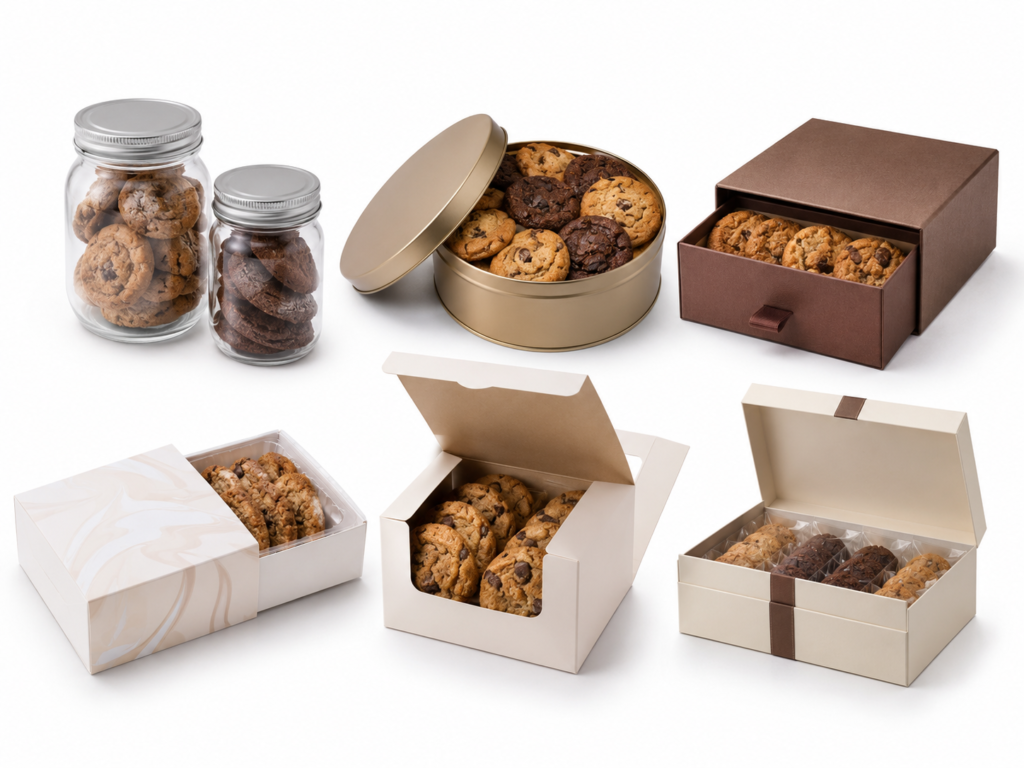
(6) Mason Jars
Mason jars are well-suited to mini cookies, butter cookies, and small crisp cookies. The clear container displays the product directly, while labels, hang tags, ribbons, fabric covers, or paper bands can be added to create a more complete gift presentation. This style is commonly used for wedding favors, seasonal gifts, market sales, and artisan bakery brands. Jars can be sold individually or arranged in sets of two or three inside a paper gift box with dividers.
(7) Cookie Tins
Cookie tins are a strong option for seasonal collections, butter cookies, and branded packaging intended for keeping and reuse. Round, square, and custom-shaped tins can all be printed, with paper cups, trays, or dividers added inside. Compared with a standard paper box, a tin has a more permanent feel and is more likely to be reused by the customer. It is particularly well-suited to vintage illustrations, bakery storefront artwork, brand stories, and limited-edition seasonal designs.
However, a cookie tin does not replace the need for sealed inner packaging. Cookies that are sensitive to moisture or grease should still be packed with inner bags or grease-resistant paper.
(8) Drawer Cookie Boxes
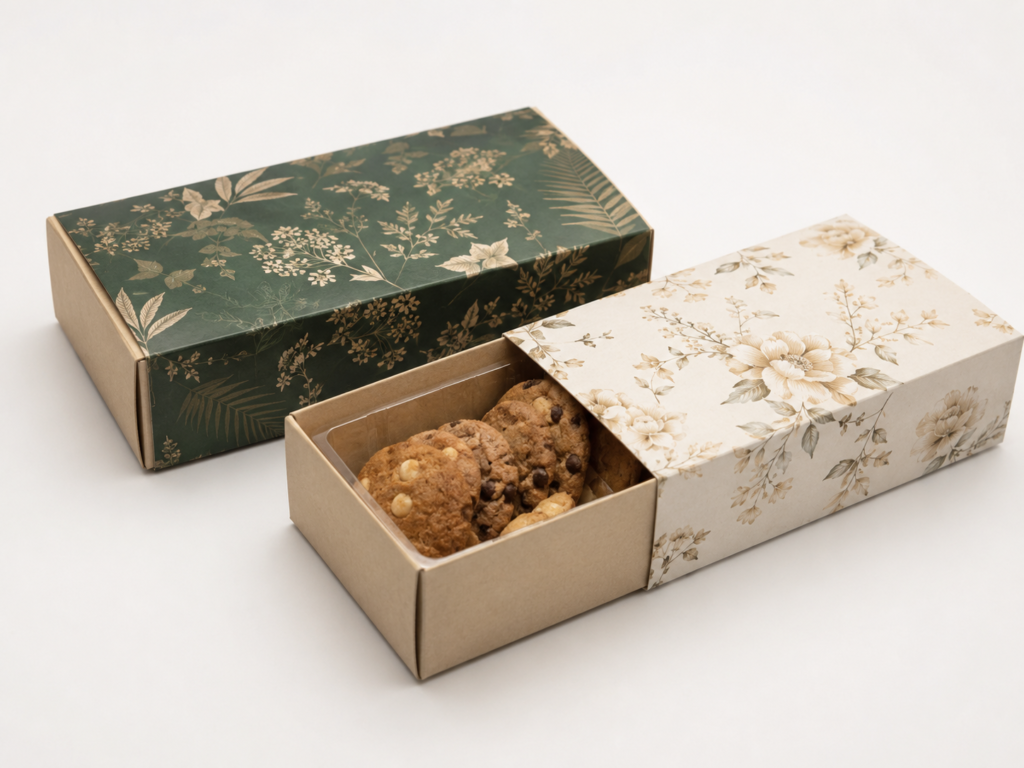
Drawer cookie boxes consist of an outer sleeve and a sliding inner tray, creating a more noticeable opening experience. They can be finished with a thumb notch, paper pull, or ribbon, and the inside can include dividers or a custom insert.This refined packaging format works well for premium cookies and wedding gift sets. We generally recommend keeping the exterior simple, then using contrasting colors, full-coverage patterns, or branded information inside to create a visual change when the drawer is opened.
(9) Sleeve and Tray Boxes
Sleeve and tray boxes offer a flexible packaging format. A standard inner tray or base box is paired with a removable printed sleeve. This approach is especially useful for seasonal collections, multi-flavor ranges, and custom corporate orders. A brand can continue using the same base structure throughout the year and simply update the sleeve artwork for Christmas, Valentine’s Day, weddings, or collaborative projects.
(10) One-Piece Flip-Top Cookie Boxes
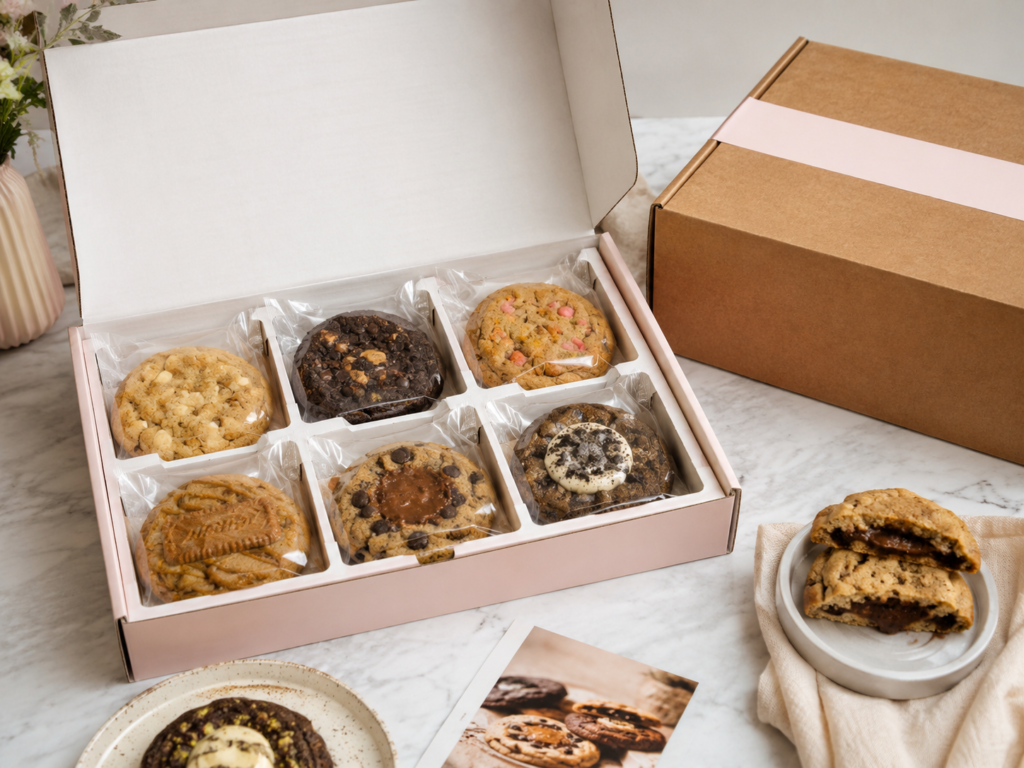
A one-piece flip-top box has a lid attached directly to the base, revealing the full cookie arrangement when opened. It can be produced from standard paperboard or made stronger with micro-corrugated or corrugated board. This format is well-suited to thick cookies, subscription boxes, local delivery, and online cookie brands selling through Instagram or TikTok. The exterior can remain simple, while the inside features brand graphics, a thank-you message, or social media details, making it particularly effective for unboxing content.
(11) Rigid Cookie Gift Boxes
Rigid cookie gift boxes are generally made from wrapped greyboard and can be produced as lid-and-base, book-style, or magnetic-closure boxes. Their thicker construction works well with finishes such as foil stamping, embossing, and specialty papers. The main advantages of a rigid box are its structure and gift appeal, but it is not suitable for every product. Rigid boxes require more storage space and increase both shipping volume and cost. They are most appropriate when the price of the cookies, the type of order, and the customer’s expectations justify the additional packaging.
3. Cookie Packaging Ideas for Different Sales Occasions
Once the cookie type and common packaging formats have been considered, the next step is to examine how the product will be sold and reach the customer. The same cookie will usually require different packaging for bakery retail, online shipping, and gift-box sales. In this section, we recommend practical cookie packaging solutions for several common sales models.
(1) For Bakery Counter Sales
Bakery counter packaging needs to solve two practical problems: customers should be able to see and understand the product quickly, and staff should be able to pack orders without slowing down service.
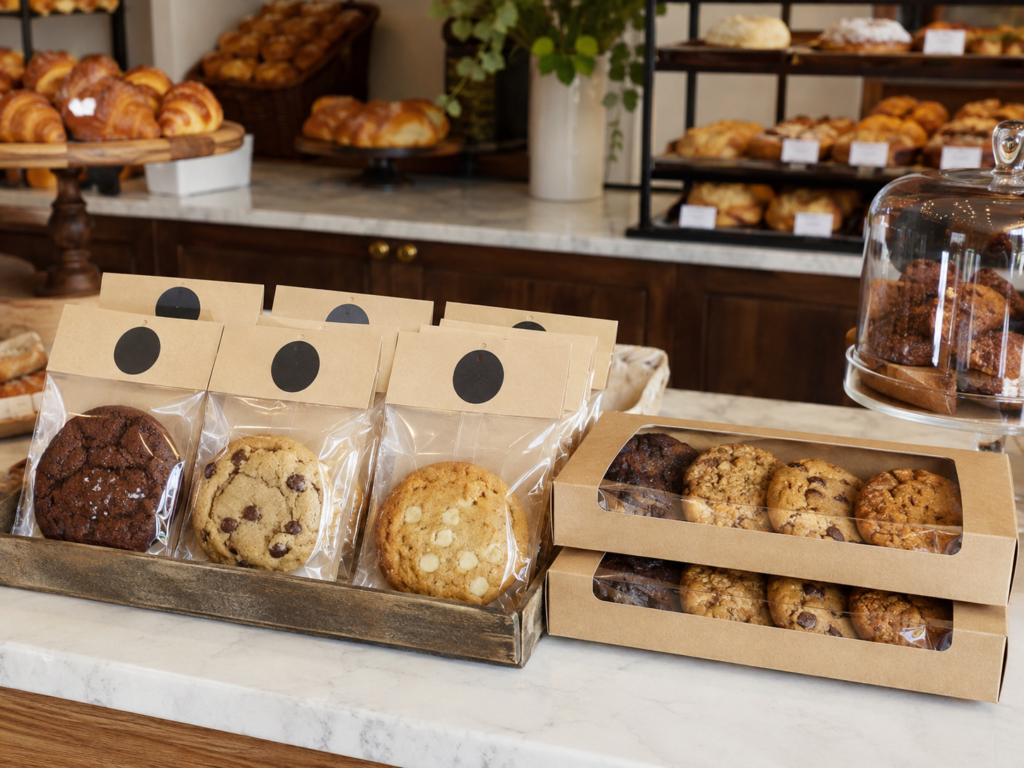
For individual decorated sugar cookies, thick cookies, or impulse-purchase items displayed near the register, two simple components can form a practical packaging system:
Individually sealed bag + printed header card or label + counter display tray
The clear bag keeps the cookie fully visible. The header card provides space for branding, flavor details, allergen information, and other product information, while the display tray keeps the packs neat and upright on the counter. Compared with placing every cookie in its own paper box, this setup is easier to restock and takes up less display space.
This format is generally used for large individual cookies. For sets of four, six, or twelve, a shallow window box is usually more suitable. Depending on the product, the box can include a grease-resistant liner, paper cups, or removable dividers:
Shallow window box + grease-resistant liner + optional dividers + branded seal
Cookies of a consistent size can be arranged directly inside the box. If the assortment contains different flavors or decorations, simple dividers can create a neater presentation and help customers identify the products more easily.
For brands operating from a central kitchen or supplying several bakery locations, it is better to avoid carrying too many box formats. A more practical approach is to establish two or three standard pack counts, such as an individual cookie, a six-cookie box, and a twelve-cookie box. Labels, sleeves, or print colors can then be used to distinguish flavors, seasonal ranges, and promotional collections. This reduces the number of packaging items each store needs to keep in stock and makes distribution from the central kitchen easier to manage.
Drawer boxes and rigid gift boxes with several assembly steps are generally not ideal for everyday counter sales. They are better reserved for seasonal collections and higher-priced sets rather than adding extra packing time to every standard order.
(2) For Instagram and TikTok Cookie Brands
Online cookie brands selling through Instagram and TikTok often attract customers through close-up product photography, cookie-pull videos, and unboxing content. They usually don’t sell small, everyday cookies. Their ranges often include oversized, thick, soft, and stuffed cookies, as well as multi-piece boxed assortments. Some brands also release new flavors each week, along with limited collections and seasonal gift boxes.
These cookies are often relatively heavy, with chocolate chunks, nuts, icing, or other decorations rising above the surface. Stuffed cookies may also vary slightly in height. The packaging, therefore, needs to look appealing on camera while preventing the cookies from shifting, pressing against one another, or leaving toppings stuck to the packaging during delivery.
For individual sales, sealed clear bags or custom-printed bags can be paired with labels or paper bands. This keeps the cookies visible and makes it easier to identify different flavors and weekly releases. For multi-cookie sets, a more practical packaging system is usually individually sealed cookies + a branded inner box with fitted positions or dividers + a corrugated shipping carton
The inner bags separate flavors and reduce direct contact between the cookies. The branded inner box organizes the products and creates the unboxing presentation, while the corrugated outer carton protects the order from pressure, impact, and repeated handling during delivery.
Boxes containing three or six thick cookies can use a single-row or double-row layout. Twelve-cookie sets are generally better arranged in individual compartments. Each fitted position should be designed around the wrapped cookie, including the sealed edge of the bag, rather than around the bare cookie alone. An oversized box allows the cookies to move, whereas a too-tight fit may press the toppings against the sides.
For brands offering local delivery only, a strong one-piece flip-top box may provide both presentation and short-distance protection. For interstate or long-distance parcel shipping, it is better to keep the branded presentation box and place it inside a closely fitted corrugated shipping carton. Tissue paper and shredded paper can improve the appearance of the unboxing, but they cannot replace properly fitted positions, dividers, or inserts.
The visual design does not need to appear entirely on the outside of the box. The exterior can remain simple, while the inside reveals brand graphics, the current flavor menu, reheating instructions, social media details, or a thank-you card. For brands that rely on short-form video and customer sharing, this gradual reveal is often more effective than placing every message on the front of the box.
(3) For Weddings and Event Favors
The most difficult part of wedding and event cookie packaging is usually not the visual design. The greater challenge is keeping the products protected and the packaging consistent across a large order while accurately including personalized details such as event dates or corporate logos.
Guest counts, name lists, and design information are often adjusted near the end of the project. If every personalized detail is printed directly on the main box, changes become harder to manage, and replacement quantities can create additional costs. Decorated and shaped sugar cookies must also remain intact after being transported to the venue. Attractive packaging is of little value if the cookies collide during packing, stacking, or handling.
For most wedding favors and event sets containing two to four cookies, one relatively reliable solution is individually wrapped cookies + clear-lid compartment box + replaceable personalized sleeve or label
The individual bags reduce contact between the cookies, while the compartment structure keeps each piece in place. The clear lid displays the designs directly. Names, dates, event colors, and corporate information can be printed on the sleeve or label rather than on the permanent box structure. If the quantity or guest list changes at the last minute, only the outer printed components need to be reproduced.
This format is also easier to stack, pack into cartons, and distribute at the venue. Staff can use sleeve colors, name labels, or numbering to separate different recipients or groups without opening every box.
If each guest receives only one cookie, the packaging can be simplified to a sealed individual bag with a printed backing card and personalized label. For multi-cookie sets, however, a clear-lid compartment box is generally more stable than placing the cookies loosely inside a standard gift box, and it helps maintain a consistent presentation across the full order.
(4) For Seasonal Cookie Gifts
A common problem with seasonal cookie packaging is the need to develop different box structures for Christmas, Valentine’s Day, Mother’s Day, and other short-term occasions. Once the season ends, unused packaging can be difficult to reuse and may end up as leftover inventory.
For most bakery brands, a safer approach is to keep one reliable base box and update the seasonal theme through custom-printed sleeves, labels, ribbons, or cards. This gives each collection a noticeably different appearance without requiring a completely new packaging structure for every holiday.
For annual limited editions, corporate gifts, or higher-priced collections, cookie tins, drawer boxes, and rigid gift boxes may be more appropriate. Whichever format is selected, the cookie count and layout should be confirmed before finalizing the box dimensions. This helps avoid choosing an oversized gift box purely for visual impact.
4.How to Package Cookies Properly
Simply put, the first step in packaging cookies is not choosing a box style. It confirms the actual cookie dimensions, thickness, decoration height, and intended pack count. If the cookies will be individually bagged, measurements should be taken after the inner packaging has been applied—including the sealed edges of the bag—rather than from the bare cookie alone. This provides a more accurate basis for planning the layout and internal box dimensions.
The next step is to select the inner packaging based on the cookie’s characteristics. Thin, crisp cookies may need sealed bags and dividers to reduce moisture exposure and contact during handling. Butter cookies can be paired with grease-resistant paper or paper cups. Decorated sugar cookies and thick cookies often benefit from individual wrapping, paper trays, or fitted inserts that prevent pressure on the surface.
The outer packaging should then be chosen according to how the cookies will be sold and delivered. Bakery retail packaging can prioritize product visibility and packing efficiency. Gift packaging emphasizes arrangement and presentation upon opening, while shipped orders often use a corrugated shipping carton around the branded inner box. A well-fitted package should allow the cookies to be packed easily without pressing against them or leaving enough space for them to move.
5. Cookie Packaging Quick Reference Chart
Packaging by Cookie Type
Cookie Type | Main Packaging Concern | Recommended Inner Packaging | Recommended Outer Packaging | Optional Add-ons |
Decorated Sugar Cookies | Scratched icing, pressure on decorations, surface contact | Individually sealed bags, paper trays, and fitted positions | Clear-lid compartment boxes, shallow window boxes | Printed header cards, tags, sleeves |
Thin and Crispy Cookies | Breakage, moisture exposure, damaged edges | Sealed bags, paper cups, dividers | Compact compartment boxes, cookie tins | Grease-resistant liners, paper cushioning |
Thick and Stuffed Cookies | Movement, pressure on toppings, inconsistent height | Individually sealed bags, paperboard supports, fitted inserts | Slim window boxes, one-piece flip-top boxes | Corrugated shipping cartons, flavor cards |
Butter and Crumbly Cookies | Grease marks, loose crumbs, untidy presentation | Grease-resistant paper, paper cups, sealed inner bags | Mason jars, cookie tins, lined paper boxes | Labels, hang tags, paper bands |
Assorted Cookie Collections | Contact between different sizes, flavor transfer, and uneven presentation | Individual bags, paper cups, dividers | Window compartment boxes, drawer boxes, clear-lid gift boxes | Flavor guides, fitted inserts, sleeves |
Do not base the box dimensions on the bare cookie alone. If the cookies will be individually wrapped, the layout and fitted positions should be developed around the packed size, including the sealed edge of the bag and the height of any decoration.
Packaging by Sales Occasion
Sales Channel or Occasion | Main Priority | Recommended Packaging System | Optional Add-ons |
Bakery Counter Sales | Product visibility, quick packing, efficient storage | Individual bag with header card, or shallow window box with grease-resistant liner | Branded seals, removable dividers, and flavor cards |
Online Cookie Delivery | Movement control, pressure protection, complete unboxing experience | Individually sealed cookies + fitted presentation box + corrugated shipping carton | Thank-you card, reheating guide, cushioning |
Wedding and Event Favors | Personalization, batch organization, and easy distribution | Individually wrapped cookies + clear-lid compartment box + replaceable sleeve or label | Name tags, date labels, ribbons |
Seasonal Cookie Gifts | Seasonal visual change with less leftover stock | Standard base box + seasonal sleeve, label, or themed card | Seasonal ribbon, inner paper, limited-edition flavor card |
Corporate Cookie Gifts | Corporate branding, batch shipping, gift presentation | Drawer box or rigid gift box + compartment insert + shipping carton | Branded sleeve, custom card, address label |
This chart is intended as a starting point. Final dimensions and materials should still be confirmed against the actual cookie, pack count, and delivery method. Two boxes may look similar from the outside, but perform very differently once the inserts, dividers, and inner packaging are taken into account.
6.FAQ
Can I start a custom packaging project with only cookie samples and pack counts, without a dieline or finished design?
Absolutely yes. Many cookie brands we work with begin without a finished design concept or dieline. As a full-service custom packaging manufacturer, EVER GREATER can help develop the packaging from the ground up. You can start by providing product samples, photographs, and an approximate pack count. Our professional design and support team is available around the clock to discuss your requirements and help turn your initial idea into a workable cookie packaging solution.
When should a cookie brand use stock boxes with branding, semi-custom packaging, or a fully custom structure?
Stock boxes finished with labels, header cards, or printed sleeves offer a quick launch and flexible order quantities. They are a practical choice for brands still testing pack counts, flavors, or sales channels, and may need to adjust their product range as demand evolves.
Semi-custom packaging is better suited to brands with an established product and visual identity that do not yet need a completely new structure. Custom printing, windows, sleeves, or liners can be added to a standard-sized box to create a more consistent branded presentation.
A fully custom structure becomes more valuable once the cookie dimensions, pack counts, and sales methods are relatively stable, especially when existing packaging creates problems with space, product arrangement, packing efficiency, or shipping performance.
Why can two cookie boxes that look similar have very different prices?
The visible appearance of a box is only one part of the quotation. Material thickness, paper grade, box dimensions, print coverage, finishing processes, and order quantity all affect the unit price.
The structure can also make a significant difference. A standard folding carton can often be die-cut and glued by machine, whereas packaging with a clear window, a custom insert, drawer construction, a magnetic closure, or hand-applied accessories requires more materials and additional production steps.
What should be tested with real cookies before approving a packaging sample?
When a plain or printed sample arrives, it should not be evaluated only for color and appearance. The best approach is to complete a full packing trial with the actual cookies, following the same process that will be used in daily sales.
Check whether the cookies are easy to place in and remove, whether the sealed edges of individual bags interfere with the fit, and whether icing or raised toppings touch the lid. Gently move and handle the package to see whether the cookies shift, tilt, or come into contact with one another. Assembly time should also be recorded, and the base strength, closure tabs, window position, and insert fit should all be checked. Packaging intended for delivery or parcel shipping should also be tested under conditions that reflect real-world sales and transport environments.
How should a growing cookie brand plan packaging for multiple cookie sizes without creating too many packaging SKUs?
It is usually unnecessary to develop a separate box for every flavor, cookie size, or promotional collection. A more efficient approach is to review the full product range and group together cookies that can share the same packaging footprint. A well-planned packaging system does not give every SKU its own box. Instead, it uses the fewest practical box formats to cover the main product range while maintaining a secure fit and consistent presentation.
Conclusion
The right cookie packaging should make the product easier to present, sell, and deliver—not add unnecessary complexity to the business behind it. With more than 25 years of packaging and printing experience, EVER GREATER has supported bakeries, restaurants, and Instagram-based dessert brands with practical packaging solutions developed around real products and day-to-day operations.