
Christmas Gift Packaging Ideas for Bakeries: How to Make Holiday Treats Gift-Ready
As Christmas approaches, customers often buy cookies, macarons, cakes, or chocolates specifically as gifts. The packaging therefore has a different job from everyday bakery packaging: it needs to protect the product while making the whole box feel ready to give.
If you are preparing this year’s Christmas collection, the Christmas gift packaging ideas below can give you a practical starting point. Each one focuses on details that can be applied to real bakery packaging, without requiring you to completely redesign what you already use. Small changes can often give everyday holiday bakery packaging a stronger festive feel and make it more gift-ready.
1.Use Clear Windows to Make Holiday Treats Part of the Design
For Christmas bakery packaging, the clear area can do more than show the product. It can be designed as part of the holiday artwork itself.
For Christmas cookie boxes with windows, for example, the opening can sit in the center of a printed Christmas wreath. Pine branches, red berries, and small stars can frame the lid, while real gingerbread men, snowflake cookies, or Christmas tree cookies show through the middle. When planning custom window boxes, you could also use an arched window with a winter bakery or Christmas storefront illustration, so the cookies inside look as though they are sitting in a shop display. The window does not need to be especially large.Keep enough printed board around the opening for the wreath, storefront, logo, or other artwork you want to frame the product with.
If your holiday assortment already has a strong color palette — such as red, white, and green macarons, or six to twelve Christmas cookies in different shapes — you can increase the transparent area. A clear PET lid works well here. There is no need to add heavy Christmas graphics across the top; the seasonal design can stay on the paper base, border, or belly band instead. A cream-colored base with red and green macarons, a small brand logo, and a simple “Holiday Collection” message on the side can already feel distinctly seasonal.
A fully clear PET box can also work, but it helps to give the product a clear holiday backdrop. You might place the Christmas cookies on a forest-green or burgundy printed base card, then build the transparent box around it. From the front and top, the treats remain the main focus, while the base card carries the Christmas color, logo, and seasonal message. For taller cupcakes or mini cakes, you can keep the sides clear and use printed paper top and bottom panels for snowflakes, pine branches, or small gold stars, leaving the transparent areas to do the actual product display.
When developing custom window boxes, it is better to lay out the products you will actually sell before deciding on the window size. If the box holds three large decorated cookies, frame those three pieces. If six macarons sit in a row, let the window follow that line. Set the product layout first, then draw the window around the pieces you actually want customers to see.
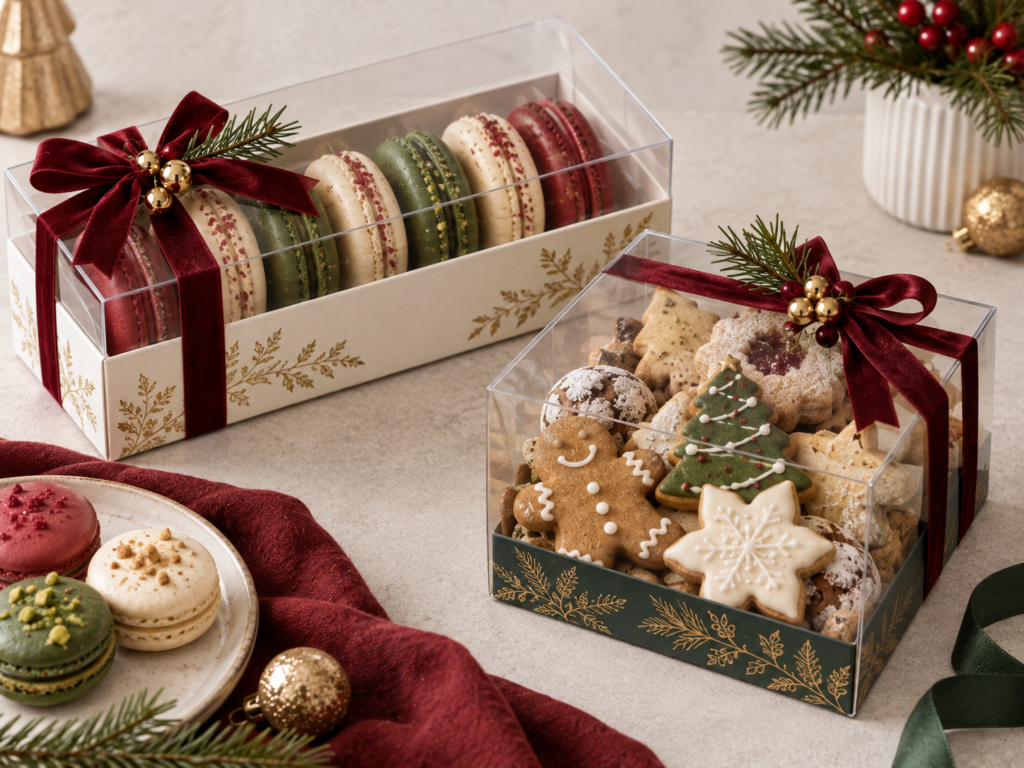
2.Add Festive Accessories Without Redesigning the Whole Box
If your everyday cookie, macaron, or dessert boxes already work well, there is no need to develop a completely new structure just for Christmas. For many bakeries, keeping the same box and changing a few of the most visible details is simpler and often makes more sense for seasonal bakery packaging.
Ribbon is one of the easiest ways to make a standard box feel more gift-ready. Cream, kraft, or solid-color cookie boxes pair well with burgundy, forest green, or gold ribbon. If the box already carries detailed artwork, a plain ribbon usually works better than another busy pattern. With custom ribbons, the logo also does not need to repeat closely across the entire length. Leaving more space between each mark often gives Christmas gift packaging a cleaner look.
Stickers are especially useful for smaller Christmas collections. You can keep using your year-round box and simply change the custom logo sticker on the closure, lid corner, or outer wrapping. A holiday version might keep your regular logo and add a small snowflake, pine branch, or short phrase such as “Holiday Edition.” Once Christmas is over, the base packaging can still be used, rather than leaving you with a large quantity of boxes printed with seasonal artwork.
Cards are useful for information that does not need to sit on the box itself. Corporate gifts may need a short holiday greeting, while a bakery may want to include flavor notes, serving suggestions, or a simple seasonal message on a separate custom card. When the customer, holiday, or product changes, you only need to update the card rather than redesign the entire package.
You also do not need to use every accessory at once. A box that already has a strong Christmas illustration may only need the right ribbon. A very simple box might work better with a sticker and a card. Start with what the existing packaging already has, then add the one or two details it is missing instead of layering every Christmas element onto the same box.
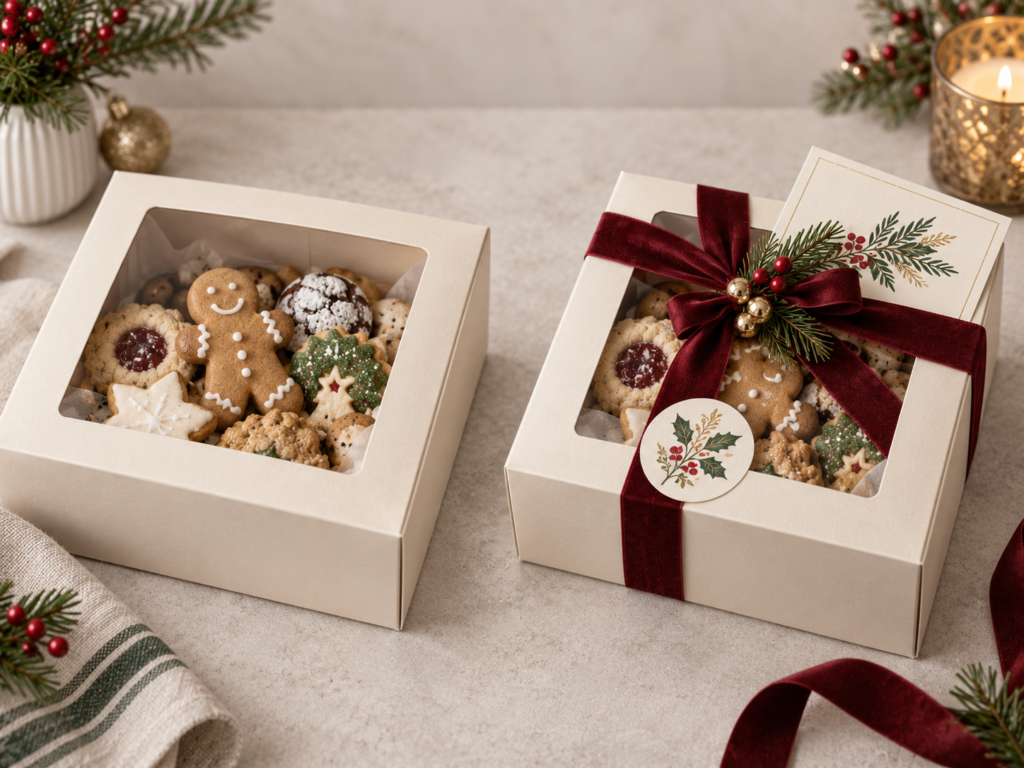
3.Bring Christmas Illustrations Onto the Box
Before drawing the Christmas artwork, look at how much uninterrupted print area the box actually gives you. A large lid can carry a full scene; a smaller carton usually works better with a repeat pattern or a few illustrations around the edges.
For cookie gift boxes or macaron gift boxes with larger lids, a full holiday scene can work well. Instead of relying only on Christmas trees and snowflakes, the artwork can feel more bakery-specific: a gingerbread house, a winter bakery, a cookie-filled shop window, rolling pins, baking trays, or a small scene built around Christmas treats. That usually feels more connected to the product than applying a generic holiday graphic to the box.
Smaller boxes are often better suited to a repeat pattern. Gingerbread figures, stars, candy canes, cookies, and pine branches can be spaced out more loosely, with the logo left in the center or at one corner. The smaller the box, the less useful a dense pattern becomes. If too many elements are packed onto the surface, the result is just a mass of Christmas motifs, while the brand and the product itself become less noticeable.
If your existing packaging already has its own color palette and layout, there is no need to replace everything for Christmas. A cream-colored box can carry a border of dark green foliage and red berries, while a more playful cookie brand can turn gingerbread men, sweets, and baking tools into a Christmas pattern.The Christmas artwork can change, but the logo placement, core colors, and overall layout can still follow the packaging customers already recognize.
Before going to print, it is worth checking the dieline again. Fine lines, crowded snowflakes, and complex gradients can easily get lost once they run across folds and corners. With custom printed Christmas boxes, keep the main artwork away from locking tabs, glue flaps, and major creases, and place the most important visual elements on the box panels that will remain fully visible after assembly.
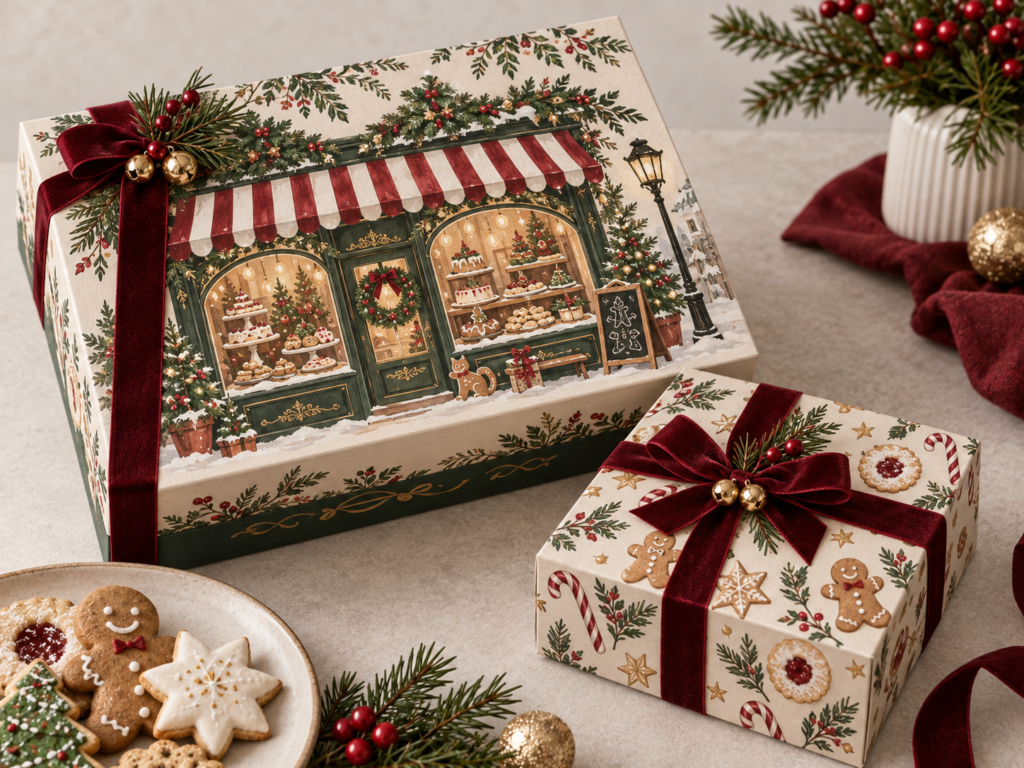
4.Use the Box Shape to Echo the Holiday
If you do not want your Christmas packaging to rely entirely on color and graphics, the box shape itself can carry some of the seasonal character. Among practical Christmas gift packaging ideas, changing the silhouette, top closure, or opening style is a simple way to make an everyday bakery box feel more festive without turning it into an exaggerated novelty package.
Cookies, gingerbread, and small desserts work particularly well with house-inspired shapes. A standard folding carton can be given a simple pitched-roof top, which immediately brings to mind a gingerbread house, winter cabin, or Christmas market stall once the box is assembled. For macarons, chocolates, or premium cookies, you could also explore hexagonal, octagonal, or cut-corner boxes that subtly echo the shape of a Christmas ornament instead of using the same rectangular format every time.
If you do not want to change the entire structure, a smaller adjustment can still make a difference. A standard bakery box might use a roof-shaped closure, an arched detail, or a layered opening at the top. If your existing box size and packing method already work well, keeping the main structure and changing only the upper section is often more practical than developing a completely new novelty shape.
The way the box opens can also make it feel more like a gift. Drawer boxes, lid-and-base boxes, and book-style openings naturally feel closer to unwrapping a present than a standard tuck-end carton. For macarons, chocolates, or Christmas cookie collections, this is one of the Christmas gift packaging ideas that can separate the holiday version from your everyday packaging without adding more decoration to the outside.
The final structure still needs to work for the product inside. For cakes, cupcakes, and other desserts that need to be delivered, easy packing, stacking, and transport matter more than an unusual shape. A pitched roof, a distinctive top closure, or a more gift-like opening is often enough. There is little benefit in making a Christmas box harder to pack, stack, or ship just for the sake of the shape.
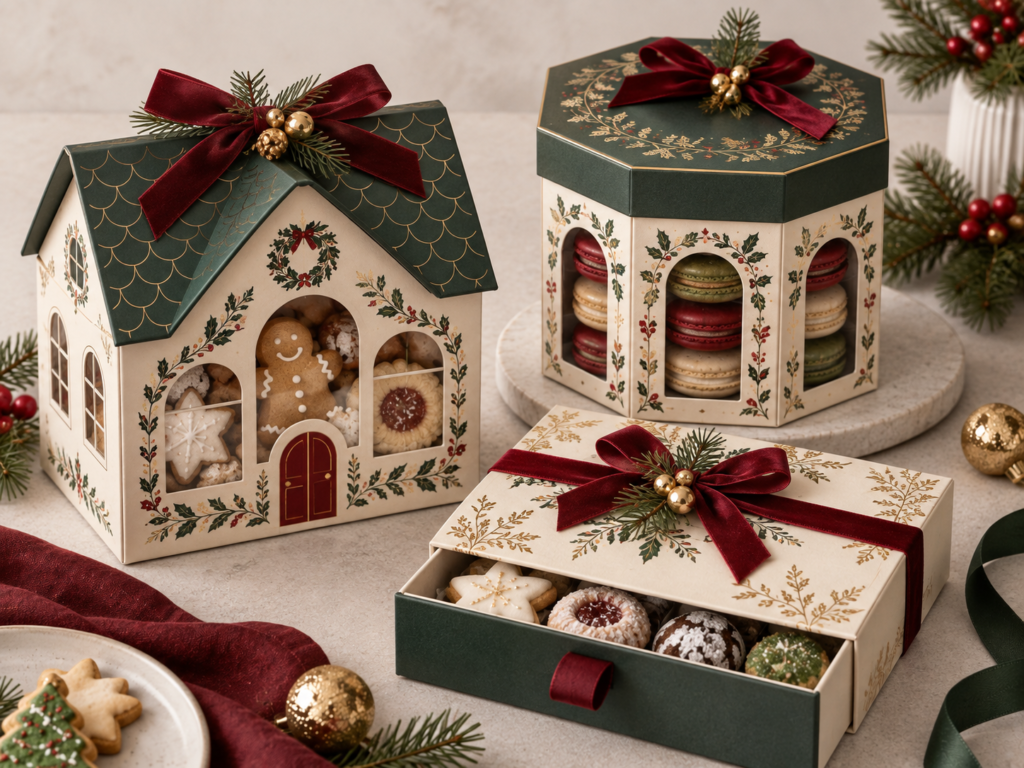
5.Let the Christmas Scene Continue Inside the Box
The inside of the box does not need a completely separate set of Christmas artwork. A better approach is to let the scene that begins on the outside continue once the box is opened.
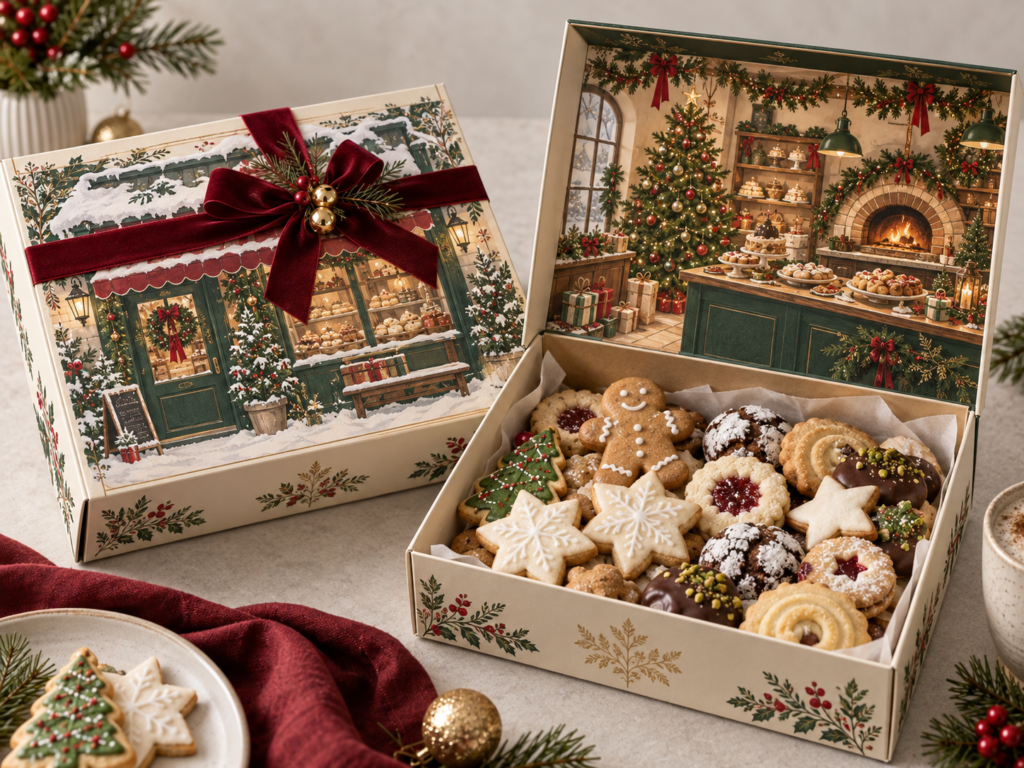
For a winter bakery-themed cookie box, the outer lid might show the shopfront, snowy roofline, and display window. Open the box, and the inner lid can carry the scene into the bakery with a Christmas tree, oven, and cookie shelves. The outside shows the storefront; the inside shows the space behind it. Keeping the wall colors, window shapes, and illustration style consistent helps the two views connect naturally.
If you do not want to create a full scene, you can continue just one small element. A pine branch that starts in the upper corner of the lid can carry across the edge and continue inside. A few gold stars on the outside can become a fuller pattern under the lid, paired with a short Christmas greeting. This usually works better than adding a completely unrelated set of snowflakes to the interior.
Decorated cookies or macarons can also become part of the inside composition. If the box holds six Christmas cookies, there is no need to illustrate another six cookies on the inner lid. Instead, use the artwork as the background of a holiday table and let the real cookies sit in the foreground. If the box contains a row of red-and-green macarons, keep the inner artwork to pine branches, candles, or wrapped gifts and let the products carry the strongest color.
This type of design is best checked at the dieline stage, with both the flat layout and the opened-box view in front of you. Look at which lines cross folds, which parts of the artwork only appear after opening, and whether the products will cover any important details.Check the flat dieline alongside an opened-box mockup before approving the artwork. You should be able to see where the scene crosses a fold, which details appear only after opening, and whether the products cover anything important.
6.Arrange the Treats to Create a Christmas Display
If your Christmas collection includes several colors and shapes, decide the assortment layout before packing starts. Otherwise, even well-designed cookies or macarons can look random once they are all in the same box.
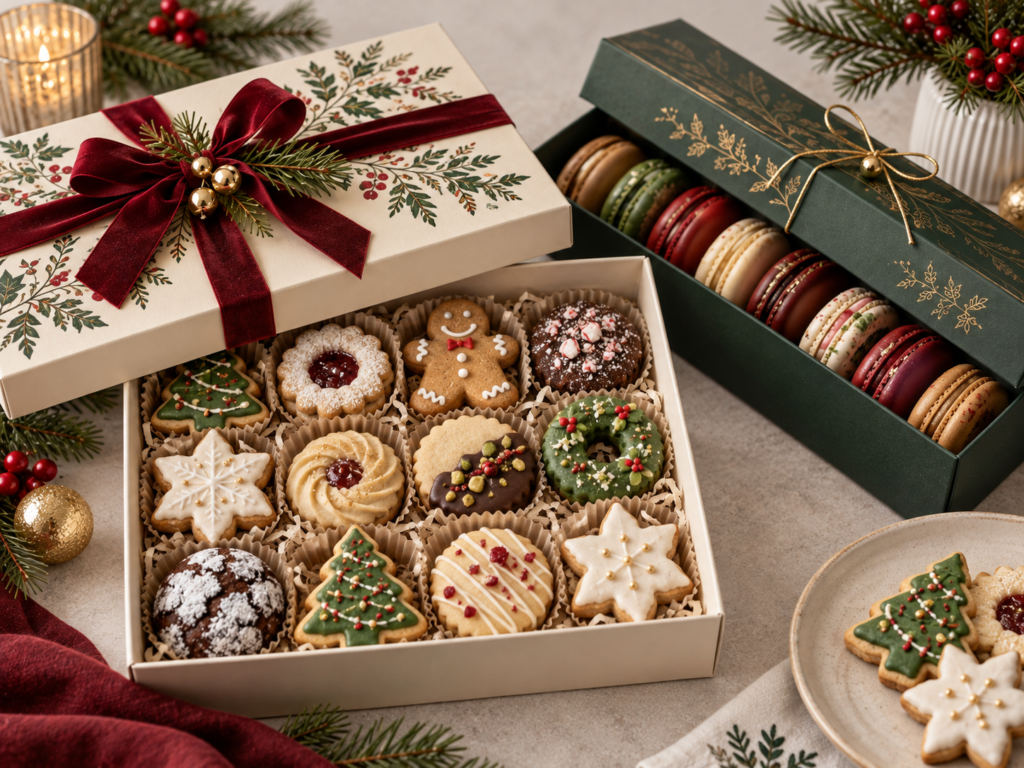
For a 12-piece Christmas cookie box, for example, you might have trees, gingerbread figures, snowflakes, and a few simpler round cookies. Instead of grouping similar shapes together, spread the colors and designs across the box. A green tree can sit next to a cream snowflake, with gingerbread tones and small red accents worked in between. Once the lid is opened, the assortment reads as a clear Christmas palette without one side becoming entirely green and the other entirely red.
Macarons benefit even more from planning the color order in advance. If your holiday range uses forest green, cream, burgundy, and caramel, decide how many of each color will go into the box, then work out the sequence before packing begins. Six or twelve macarons can still sit in simple rows; the important part is to alternate darker and lighter tones rather than letting several burgundy or forest-green pieces cluster together.Even in a plain outer box, that planned color sequence makes the assortment read as a Christmas collection as soon as the lid is opened.
The same approach works for an assorted cookie gift box. Decorated cookies with heavier icing or stronger colors do not need to sit together in one area. Mixing them with lighter, simpler shapes gives each design enough room to be seen and keeps one part of the box from feeling too busy.
Before you finalize the internal dimensions of the gift box, lay out the actual holiday assortment at full size. You will quickly see how the colors sit together, whether the spacing feels right, and which combinations look too heavy.Once the arrangement is fixed, the tray or dividers can simply be made to hold those positions.
7.Frequently Asked Questions
How early should you finalize and order custom Christmas packaging?
It is best to plan backward from the date you want to launch your Christmas collection. Leave enough time for box confirmation, sampling, artwork changes, printing, production, and shipping. Special structures, inserts, or finishes may need more time. EVER GREATER can help you plan the timeline based on your target delivery date, box type, and shipping method.
Can the same Christmas design be adapted across different box sizes and bakery packaging SKUs?
Yes, but the artwork should not simply be resized for every box. Cookie boxes, macaron boxes, and cake boxes have different shapes, folds, and printable areas, so the logo, illustrations, and main design elements usually need some adjustment. This keeps all packaging SKUs looking like part of the same Christmas collection without damaging the layout.
What should you consider when bakery products come into direct contact with the gift box?
If cookies or other bakery products will touch the box directly, make sure the paper, coatings, inks, and other materials are suitable for food contact. Greasy cookies, moist cakes, and dry products may need different packaging solutions. If the food is individually wrapped, you usually have more flexibility with the outer gift box. It is better to confirm this before the final design is approved.
How do multiple Christmas packaging sizes or SKUs affect MOQ and production?
Different sizes or SKUs usually need their own quantity, dieline, artwork file, and structural confirmation. Even if they use the same Christmas design, different box sizes may still require separate production setups, so the MOQ cannot always be combined. EVER GREATER supports low-MOQ and multi-SKU custom packaging projects, which can be useful if you are testing a new Christmas collection.
How can you reduce leftover Christmas packaging after the holiday season?
Try not to print every seasonal detail directly on the main box. A year-round box can be paired with Christmas stickers, ribbons, cards, or other removable elements, and avoiding a specific year makes the packaging easier to reuse. If demand is still uncertain, a low-MOQ first order can also help you test sales before placing a larger repeat order.
Conclusion
Christmas packaging works best when the seasonal idea suits both the product and the box you already need to use. A clear window, a small accessory, a well-placed illustration, or a change to the opening can be enough to turn everyday bakery packaging into something ready for Christmas gifting.
EVER GREATER has 25+ years of packaging and printing experience, working with bakeries, restaurants, and social-media-led food brands on custom packaging projects. If you already know your product size, quantity, or design direction, we can help turn those details into Christmas bakery packaging that is practical to produce.